
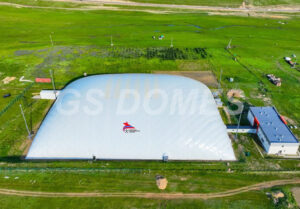
Many years, the brutal winter season in Mongolia was preventing the growth of football. If it gets down to approximately –40°C outside, you really have hard time keeping up with regular sports practices, teams often end up shortening their playing season or going on a long training trip abroad for winter training. Mongolian football simply required much more than a traditional indoor hall—it needed the construction of a massive stadium that can handle harsh cold and at the same time offer ample, clean, and trustworthy professional training conditions throughout the year.
Besides creating a huge and a self-contained air-supported football stadium over the playing area, there won’t be any obstruction because you don’t have columns inside. Local sources indicated that the whole air dome measures roughly 120 ×80 × 27.5 m, and that the amount of air enclosed in it was about 273,000 m³. The playing ground remains uninterrupted in all directions, which gives the players space to do their drills as they would in an open field with an impressive height to head clearance. The main advantage of the air dome is that it uses a continuous stream of air pressure in a controlled way to hold up the entire structure and to provide a huge span of uninterrupted sports hall.
However, the greatest challenge was winter! According to the news report of the local media, when it was around –40° C outside, the indoor atmosphere maintained temperatures of approximately 10°C. Normal winter operating temperatures were 10–15°C, according to reports. The air dome in conjunction with the heating and ventilation systems has enabled the change of weather-dependent outdoor football fields to indoor training facilities available all twelve seasons. The football players can go on with their training no matter the snow, harsh winds, or freezing cold outside, which is a good example of how the use of air-supported buildings can be the key to turning sports into possible things to do in places where climate used to dictate sports activities.
Naturally, it’s not only about the temperature control that matters. Before this facility became operational, the teams from Mongolia sometimes spent the winter training days in the neighboring Asian countries, traveling around 30-40 of them for each trip. It was the football players, plus support staff, and a significant amount of the money spent on the whole trip, including flight tickets, hotels, meals, transport, and the training facility. When a football season comes round at home, the possibility of conducting more and better training sessions here also increases. This project is not merely a solution to an engineering problem, but it is a huge step towards the reduction of players’ training costs, the ease of use of training venues, and the development of football in Mongolia.
We have to say it was really impressive how after the construction of the air dome, Mongolia did use it and that there was a great response of users to it. Also, the facility got featured by some Mongolian media outlets. Finally, the year of 2023 marks the point where the air dome project won the ‘Best Construction’ award at Mongolias ‘Börte Chono 2023’ sports ceremony. From addressing the problem of extremely cold winters to backing football all year round and winning the national recognition, the Mongolia Football Air Dome demonstrates what an air-supported building can do: convert an unbearable location into an environment where sports can thrive.


