
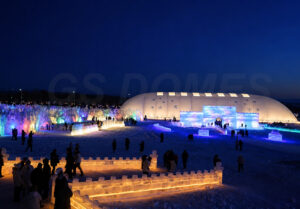
In Altay, Xinjiang, where winter is not only the season but a significant part of the region’s unique features, a new ice and snow destination welcoming visitors since February 2026 has become a hot spot. Located at Xuedu Village, Aweitan Town, the Altay Ice & Snow Theme Park offers an intriguing mixture of ice-based attractions in winter season, performing arts, recreational activities in snow and night-time attractions. Surrounded by a snow-white landscape and facing the harsh winter weather in northern Xinjiang, the park project required something besides just impressive, outdoor entertainment—it also necessitated a warm indoor space for visitors who might want to take a break from the cold, have some rest, and get re-energized. To that end, a GS DOMES air-supported pavilion was added to the facility as exclusively designated rest space for the visitors, showing how membrane structures could aid tourism development even in the most severe cold conditions.
Altay, which has been blessed with extremely long winters and high snowfall together with the very cold weather creating challenging conditions for typical lightweight structures, was the perfect site to implement the GS DOMES solution: an air-supported membrane structure that is based on a constant flow of internal air pressure maintaining the shape of the building and at the same time, the membrane cover and supporting structure system are both playing their role for handling the outside wind and snow loads. An air dome, unlike conventional steel-intense buildings, achieves large indoor column free area by means of a lightweight structural system that makes the air dome particularly suitable for tourism facilities which only exist for certain seasons, Winter Olympic venues, large spanning constructions within snow region etc.
Along with the building performance, the temperature management system is another crucial factor. While out of the dome, the visitors might be exposed to very low temperatures, snow and strong winds, in and out of the rest hall, the visitors get a comfortable and regulated temperature during the relaxation breaks they make after participating in various outdoor activities. An insulated air domes system consists of several layers of membrane, thermal insulation and a controlled heating, ventilation and air conditioning (HVAC) system to minimize heat loss and maintain a constant indoor climate, thereby significantly improving thermal performance. The continuous membrane cover also effectively prevents the creation of unnecessary vents and thermal points of weakness which are commonly associated with conventional structures. In terms of cold snow environment buildings, the presence of such structures indicates that even in the worst weather conditions, these buildings can perform as efficient heated indoor rest zones for visitors that, among others, will increase the visitors’ comfort level and support winter operations to run smoothly.
Another benefit related to winter tourism that can be brought out from the project is the fact that air-supported buildings can be put up within a very short period. Snow-sport and snow-play centers are highly seasonal, so the timeline of constructions becomes a critical point.
Unlike standard large-span constructions, there is a huge reduction in weighty elements with air dome structures and much of the membrane system and support equipment can be manufactured off-site.This makes it possible to complete installation with a great pace even in periods of tight time frame. Moreover, once the hall opens, this indoor area which is free from columns will make it possible for visitors to have enough space not only for relaxation but also for other purposes if desired. Through this, the operator will benefit from the adaptability to use different functions as and when the tourist demand varies.
To GS DOMES, an air dome can be applied in more varied situations than football or tennis courts and warehouses—it’s also a quick, adaptable, and energy-efficient construction option that could be a great fit not only for the ice and snow tourism, ski resorts, and winter sports venues that are built in these locations but also for any cold regions that experience extreme cold.
By putting snow, wind, and extreme cold at centre stage to define the engineering challenge, a small rest hall at Altay Ice & Ski Resort is showcasing a pretty straightforward idea: if the climate changes in a way which makes it very extreme, the building solution also needs to be engineered with such a kind of environment in mind.


