

Project Background
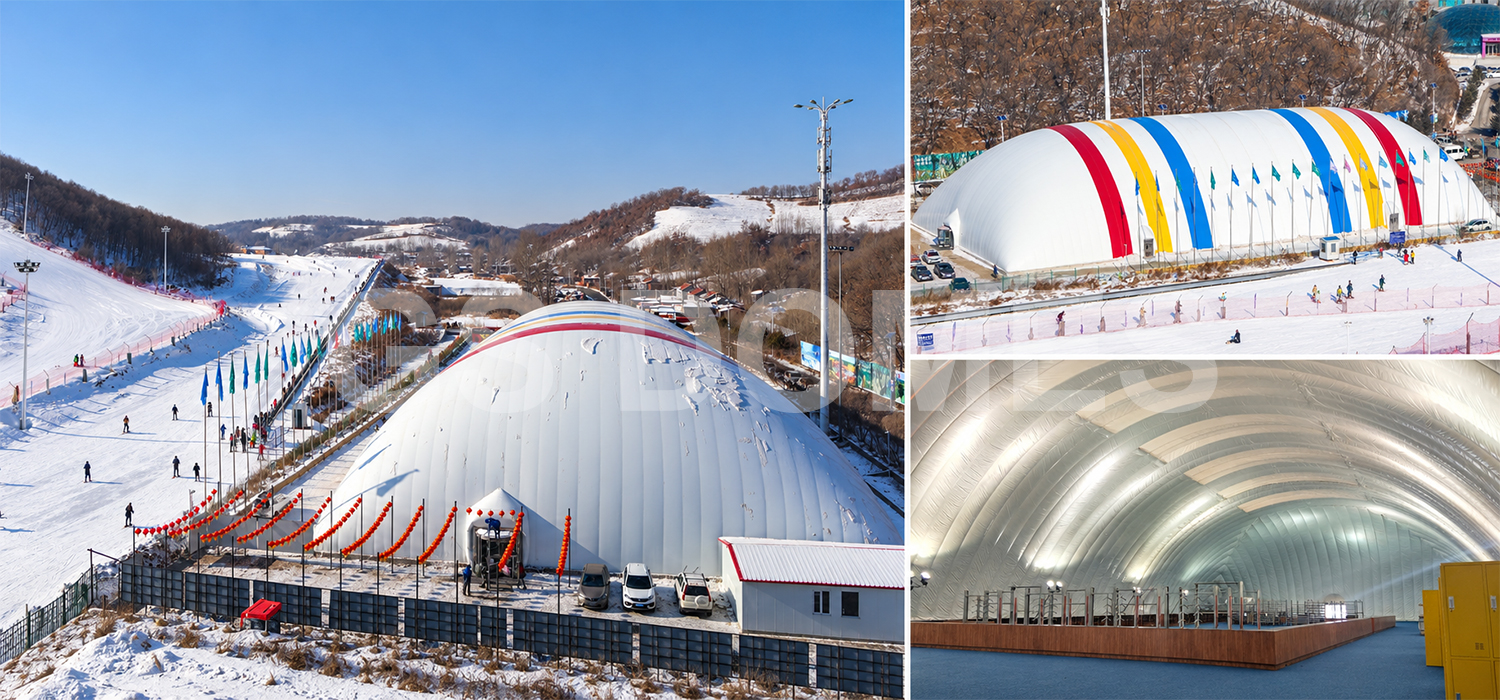
This 2,400 m² air-supported building in Changchun, China, was one of the earliest GS DOMES projects and the first air dome we built for a ski resort reception center.
The building sits directly beside the ski slopes. During the winter season, visitors use it as a warm indoor space for reception, rest, changing clothes and temporary gathering between outdoor activities.
That sounds simple until the local climate enters the equation.
Changchun has long, cold winters. The building has to operate while the outdoor temperature stays well below freezing, snow remains on the surrounding slopes and large numbers of guests move between the heated interior and the cold outside throughout the day.
For this project, keeping the structure standing was only part of the job. We also had to control snow accumulation, indoor temperature, condensation and air pressure through an entire ski season.
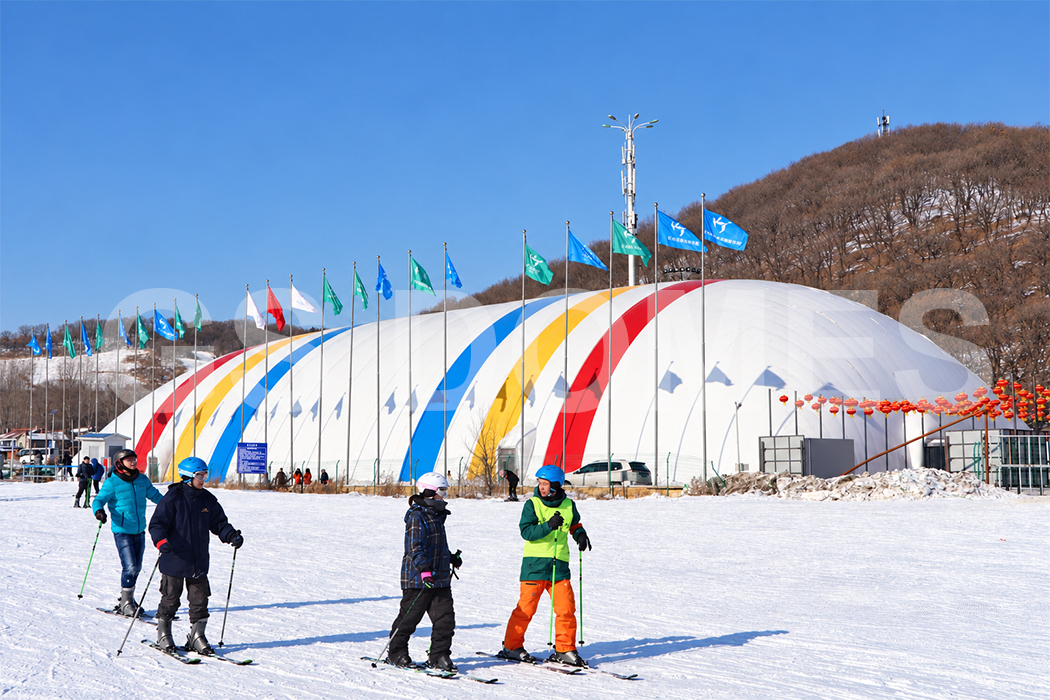
A Reception Hall Built for a Real Northeast China Winter
A ski resort reception center works very differently from an ordinary sports dome.
People constantly enter with snow on their boots and clothing. Exterior doors open frequently. Warm, humid indoor air meets a membrane surface exposed to sub-zero temperatures outside. At the same time, snowfall can continue for hours.
These conditions affect the membrane, insulation, ventilation system and pressure-control equipment at the same time.
For GS DOMES, the design started with the local winter conditions rather than with a standard building size.
The 2,400 m² enclosure uses an air-supported structural system. Continuous internal air pressure keeps the membrane in its designed shape, while the blower and control system adjusts operating pressure according to weather conditions.
During normal winter operation, the control system monitors internal pressure continuously. When wind or snow conditions change, operators can raise the pressure setting within the designed operating range.
Snow Load Came First
Snow was one of the main engineering questions on this project.
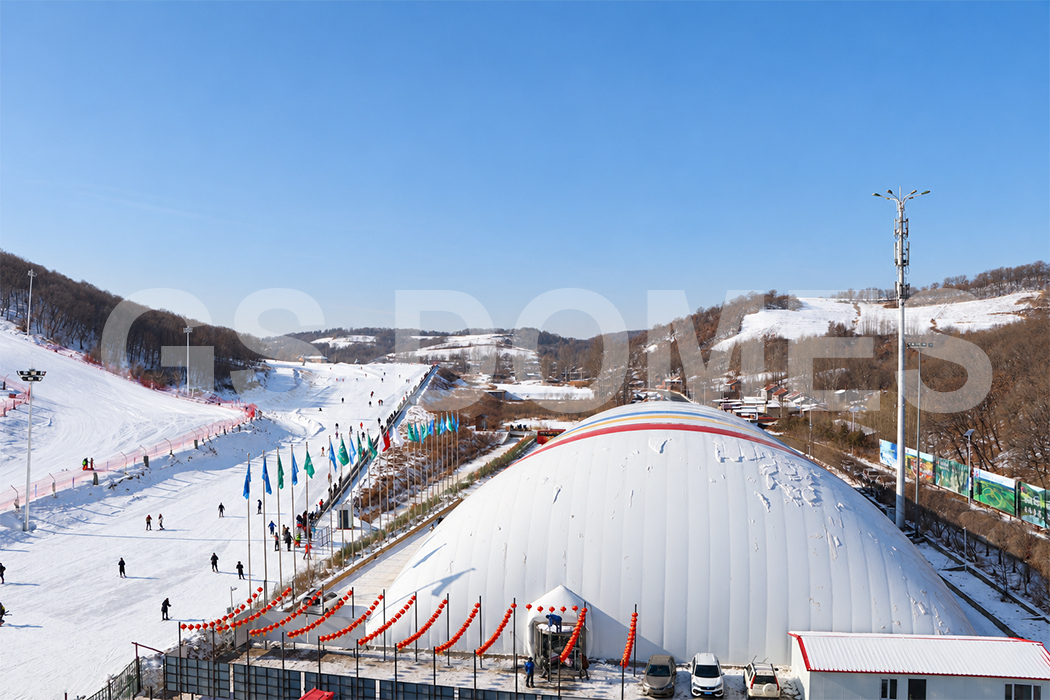
A ski resort naturally sits in an environment where snowfall cannot be treated as an occasional event. The membrane therefore needs sufficient curvature and internal pressure to prevent large areas of snow from remaining on the roof.
GS air dome projects can be engineered for snow loads roughly within the 80 to 200 kg/m² range, depending on local building requirements, project geometry and site conditions.
For the Changchun project, the dome profile allows snow to move toward the lower sides of the building instead of collecting on a flat roof surface.
Pressure control also matters.
When heavy snow is forecast, the operating system can increase internal pressure according to the project settings. The membrane becomes more resistant to deformation and maintains its designed curvature under external loading.
Snow removal around the perimeter still forms part of winter maintenance. Once snow slides from the membrane, staff need to prevent large piles from building up against the lower edge of the structure.
That detail sounds small on a drawing. On a ski resort in January, it matters every day.
Managing the Temperature Difference
The temperature difference between the inside and outside creates another problem.
Guests expect a reception hall to feel comfortable even when the ski slope outside sits far below freezing. Heating the air alone does not solve that.
Without proper insulation and airflow control, warm indoor air reaches a very cold membrane surface. Water vapor can then condense, particularly near entrances, roof areas and places with weaker air circulation.
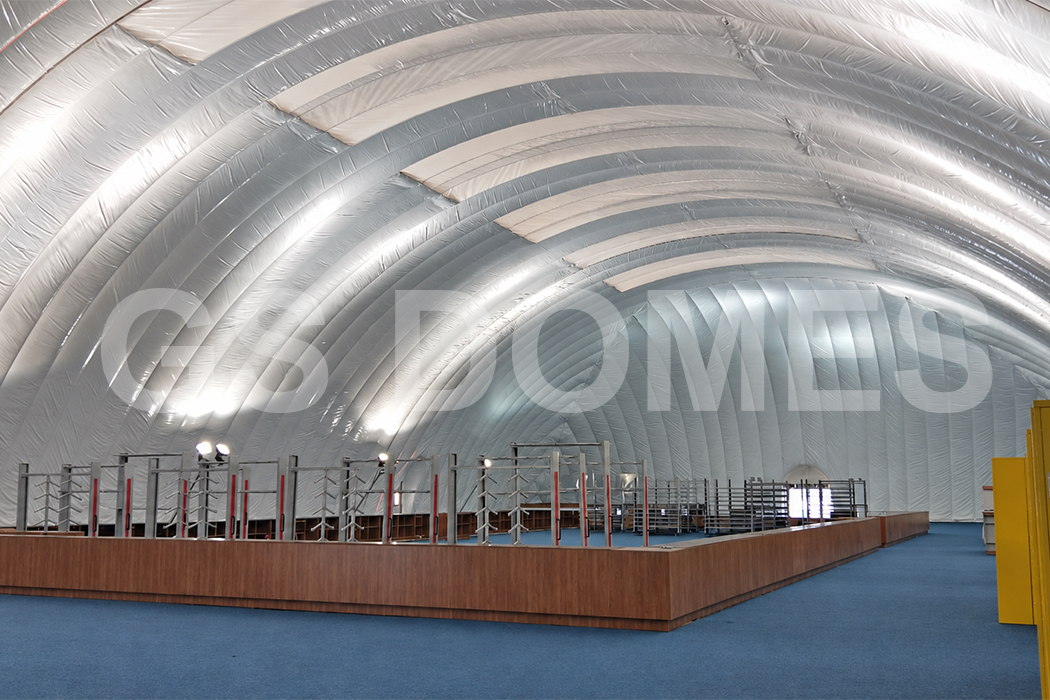
The membrane system for cold-climate projects therefore uses multiple layers. An outer structural membrane handles weather exposure, while an inner membrane and insulation layer reduce heat transfer.
GS DOMES normally designs its air-supported structures for operating environments ranging approximately from -50°C to +70°C, with the final specification adjusted for the actual project location.
The heating and fresh-air system also works together with the dome pressure system. A ski resort reception hall needs enough fresh air for occupied periods without sending excessive heated air directly outside.
Finding that balance saves energy and keeps the indoor environment more stable.
Stainless Steel Roof Exhaust Valve
The roof exhaust valve has a practical job in this building.
Warm air rises. In a heated reception hall, the highest part of the dome naturally collects warmer air and moisture. A roof-mounted exhaust valve gives the control system another way to regulate airflow and pressure.
For a cold-climate project, GS uses stainless-steel components for exposed ventilation equipment because moisture, snow and repeated freeze-thaw cycles can be hard on ordinary metal parts.
The valve connects with the building control system rather than operating as an isolated vent.
During normal operation, it helps release excess air and maintain the selected pressure range. During ventilation or abnormal pressure conditions, the system can adjust exhaust according to the operating logic.
The location at the highest part of the dome also helps remove warm, humid air before moisture accumulates excessively near the roof membrane.
Air Dome Standards for Extreme Cold Conditions
There is no useful cold-weather air dome specification based on temperature alone.
For this type of project, GS DOMES checks the building as a complete system.
The engineering team looks at local minimum temperature, design snow load, wind speed, altitude, site exposure and expected indoor temperature before confirming the membrane and mechanical configuration.
For cold-region projects, our typical design range can include:
| Item | Typical GS DOMES Design Range |
|---|---|
| Operating temperature | -50°C to +70°C |
| Snow load | 80–200 kg/m² |
| Wind resistance | Approx. 100–150 km/h |
| Outer membrane | Approx. 1150–1350 g/m² PVDF membrane |
| Inner membrane | Approx. 650 g/m² PVC membrane |
| Structural system | Continuous positive air pressure |
| Power protection | Main power plus backup power system |
| Pressure control | Automatic monitoring and adjustment |
These figures describe our usual engineering range. The final values come from the structural calculation for each site.
Changchun makes that distinction easy to understand. A specification that works for a mild-climate sports hall cannot simply be copied onto a ski resort surrounded by snow.
What We Learned From the First Project
Looking back at this project, the building itself appears quite simple: a white air dome beside a ski slope.
The engineering behind it was less simple.
Snow had to move off the membrane. The indoor space had to stay comfortable while people repeatedly opened the entrances. Pressure had to remain stable through changing weather. Heating, fresh air, exhaust, insulation and backup power all had to work together.
That first 2,400 m² ski resort reception center gave the GS team practical winter operating experience that later became part of our cold-region air dome design work.
Years later, the same questions still come up whenever we receive an inquiry from a ski resort or another project in a severe winter climate:
How much snow will the site receive?
How cold does it get?
What indoor temperature does the owner expect?
How many people will use the building?
What happens if the main power fails?
Those questions determine the building long before the membrane goes into production.
For a ski resort, that is where a reliable air dome project really starts.


